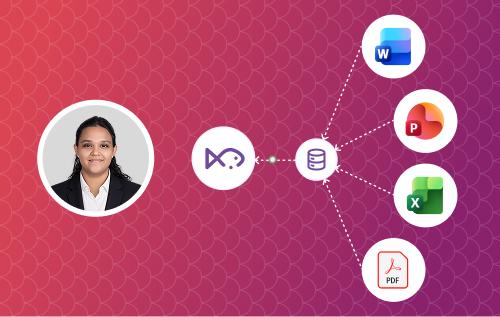



Discover how Ragfish uses agentic RAG to orchestrate multiple knowledge sources, execute multi-step tasks, validate evidence, and answer complex business questions.

The Challenge
Enterprise information is rarely stored in a single location.
Business data is typically distributed across multiple systems, including:
Databases
Internal documents
Customer support systems
Financial reports
Knowledge bases
Connected business applications
Traditional AI knowledge systems can retrieve information from a document or search across a knowledge base. However, complex business questions often require information from multiple sources.
Consider a business user asking:
"Why did Product A sales decline last quarter, and were there any customer issues that may have contributed to the decline?"
Answering this question requires more than document retrieval.
The system may need to:
Retrieve Product A sales data.
Compare the current quarter with historical periods.
Identify when the sales decline occurred.
Retrieve customer support tickets for the same period.
Identify product-related complaints.
Analyze complaint trends.
Compare sales and customer issue patterns.
Generate a final answer based on the available evidence.
No individual source contains the complete answer.
The challenge is therefore not simply retrieving information.
The challenge is orchestrating multiple knowledge and data sources to construct an answer.
The Ragfish Approach
Ragfish uses the concept of a Channel as a logical knowledge environment.
A Channel can contain or connect multiple information sources, including:
Documents
Databases
Knowledge repositories
Connected Channels
Other enterprise data sources
For complex questions, Ragfish can introduce an orchestration layer that treats the user's question as a multi-step problem.
Instead of directly asking:
"Which document contains the answer?"
The system first determines:
"What information is required to answer this question, and where can that information be found?"
Step 1: Understanding the User's Question
The first stage is to understand the information requirements behind the question.
For the query:
"Why did Product A sales decline last quarter, and were there any customer issues that may have contributed?"
The system identifies multiple information requirements.
Sales Analysis
The system needs:
Product A sales data.
Current quarter sales.
Previous period sales.
Sales trend information.
Customer Analysis
The system needs:
Customer complaints.
Support tickets.
Product A-related issues.
Complaint trends during the same period.
Cross-Source Analysis
The system must then determine:
Whether sales actually declined.
When the decline occurred.
Whether customer complaints increased.
Whether the issues are related to Product A.
Whether the available evidence indicates a possible relationship.
The question is therefore converted into a structured set of tasks.
Step 2: Task Planning
The orchestration layer creates an execution plan.
Task 1
Retrieve Product A sales data for the requested period.
Task 2
Retrieve historical sales data for comparison.
Task 3
Calculate the sales change.
Task 4
Identify the period where the decline occurred.
Task 5
Retrieve Product A customer support issues.
Task 6
Analyze complaint categories and trends.
Task 7
Compare sales trends and customer issue trends.
Task 8
Generate an evidence-based explanation.
This allows the system to break a complex question into smaller executable operations.
Step 3: Channel Discovery
Each task must be mapped to the appropriate Channel.
For example:
Sales Intelligence Channel
↓
Sales Database
Historical Sales Reports
Customer Intelligence Channel
↓
Support Tickets
Customer Feedback
Complaint Records
The orchestration layer does not need to directly understand every underlying data source.
Instead, Channels expose their capabilities.
For example:
Sales Channel
Capabilities:
- Product sales analysis
- Historical sales comparison
- Regional sales analysis
- Revenue trends
Customer Channel
Capabilities:
- Support ticket analysis
- Complaint trends
- Product-related customer issues
- Customer feedback analysis
The orchestration layer can then select the appropriate Channel based on the task.
Step 4: Multi-Source Execution
Once the execution plan is created, Ragfish begins executing the tasks.
For the sales analysis:
Query Sales Channel
↓
Identify Product A
↓
Retrieve Quarterly Sales Data
↓
Compare Historical Periods
↓
Calculate Sales Difference
For customer issues:
Query Customer Channel
↓
Retrieve Product A Tickets
↓
Filter Requested Time Period
↓
Group Complaint Categories
↓
Identify Complaint Trends
The results from both processes are then passed back to the orchestration layer.
Step 5: Result Normalization
Different sources may return information in different formats.
For example:
Sales Database
→ Structured Data
Support System
→ Ticket Records
Product Documents
→ Unstructured Text
Business Reports
→ Semi-Structured Information
Before cross-source analysis can happen, the results need to be normalized.
A simplified representation could look like:
{
source: "Sales Channel",
entity: "Product A",
period: "Q2",
metric: "Sales",
value: "12% Decline"
}
And:
{
source: "Customer Channel",
entity: "Product A",
period: "Q2",
metric: "Complaints",
value: "31% Increase"
}
This creates a more consistent representation for downstream analysis.
Step 6: Cross-Source Reasoning
The orchestration layer now has access to findings from multiple Channels.
For example:
Sales Trend
↓
12% Decline
Customer Complaints
↓
31% Increase
Primary Complaint Category
↓
Delivery Delays
The system can now evaluate whether the results overlap across:
Time periods.
Products.
Regions.
Customer segments.
Complaint categories.
This allows the system to generate a more meaningful explanation.
However, an important engineering principle is maintained:
Correlation should not automatically be presented as causation.
The system should distinguish between:
Direct evidence.
Strong correlation.
Possible relationships.
Unsupported assumptions.
Step 7: Evidence Validation
Before generating the final response, the system evaluates whether sufficient evidence has been collected.
The orchestration layer can check:
Were all required tasks completed?
Did the relevant Channels return data?
Are the time periods aligned?
Are the product identifiers consistent?
Is there enough evidence to support the conclusion?
If required information is missing, the system can:
Search an additional connected Channel.
Execute another query.
Modify the task plan.
Clearly communicate uncertainty.
This creates an adaptive execution loop.
Plan
↓
Execute
↓
Observe
↓
Evaluate
↓
More Information Required?
↓
Yes → Continue Execution
No → Generate Answer
Step 8: Generating the Final Answer
After the required information has been collected and validated, Ragfish generates a consolidated response.
For example:
Product A sales declined by 12% during the last quarter, with the largest decline occurring in the final month of the period. During the same period, customer complaints related to delivery delays increased by 31%. The increase in delivery-related issues overlaps with the sales decline period and may have contributed to customer dissatisfaction. However, the available data indicates correlation rather than direct causation.
The final answer is generated from multiple sources rather than retrieved from a single document.
Technical Architecture
The architecture can be represented using the following layers.
USER QUESTION
↓
QUESTION UNDERSTANDING
↓
TASK DECOMPOSITION
↓
ORCHESTRATION ENGINE
↓
CHANNEL CAPABILITY DISCOVERY
↓
┌─────────────────┼─────────────────┐
↓ ↓ ↓
SALES CHANNEL CUSTOMER CHANNEL FINANCE CHANNEL
↓ ↓ ↓
DATABASE SUPPORT SYSTEM REPORTS
↓ ↓ ↓
└─────────────────┼─────────────────┘
↓
RESULT NORMALIZATION
↓
CROSS-SOURCE REASONING
↓
EVIDENCE VALIDATION
↓
FINAL RESPONSE
Key Engineering Components
Channel Registry
The Channel Registry maintains information about available Channels and their capabilities.
Possible metadata includes:
Channel identifier.
Description.
Supported capabilities.
Connected sources.
Available tools.
Permissions.
Connected Channels.
This allows dynamic source discovery.
Task Planner
The Task Planner converts a user question into multiple executable tasks.
Its responsibilities include:
Identifying required information.
Determining dependencies between tasks.
Creating an execution sequence.
Identifying missing information.
Channel Router
The Channel Router determines which Channel should execute each task.
Routing decisions can be based on:
Channel capabilities.
Data relevance.
User permissions.
Source availability.
Task requirements.
Execution Engine
The Execution Engine manages multi-step task execution.
It is responsible for:
Invoking Channels.
Calling appropriate tools.
Tracking execution state.
Handling failures.
Requesting additional information when required.
Result Processor
The Result Processor converts information from different sources into a consistent representation.
This enables:
Cross-source comparison.
Entity matching.
Time period alignment.
Structured reasoning.
Validation Layer
The Validation Layer ensures that final answers are supported by available evidence.
It can verify:
Data completeness.
Source consistency.
Task completion.
Evidence quality.
Confidence levels.
Business Impact
Agentic Channel Orchestration allows Ragfish to support a different class of enterprise questions.
Instead of only answering:
"What information exists?"
The system can begin answering:
"What happened?"
"Why did it happen?"
"What information across the organization explains it?"
"What should we investigate next?"
This transforms the role of AI from a document search interface into an intelligent knowledge orchestration layer.
Conclusion
The challenge in enterprise AI is not simply connecting more data sources.
The real challenge is enabling AI to intelligently navigate across those sources.
With an Agentic Channel Orchestration architecture, Ragfish can approach complex questions as multi-step workflows.
The system can:
Understand the user's goal.
Break the question into tasks.
Discover relevant Channels.
Access multiple data sources.
Execute multiple steps.
Combine information.
Validate evidence.
Generate a consolidated answer.
The result is an architecture designed not only for retrieving information, but for orchestrating knowledge across the enterprise.
For Ragfish, this creates a potential foundation for moving beyond traditional RAG and toward a more intelligent, agentic approach to enterprise knowledge systems.