


Ragfish Logo
Get In Touch
Ragfish Logo

Book a Demo

A Modular Architecture for Enterprise AI

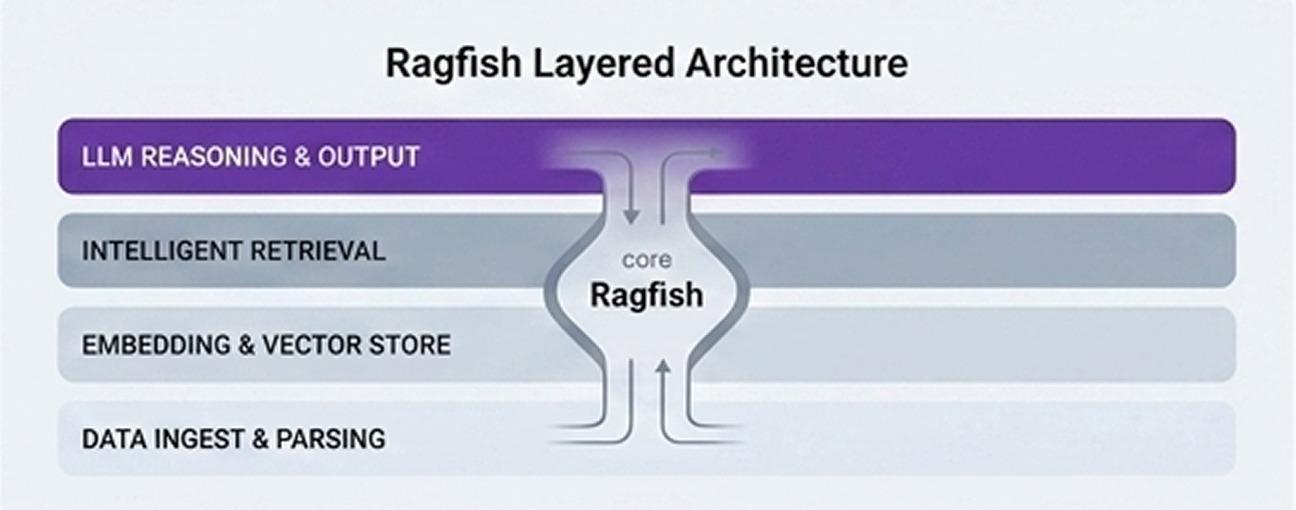
Ragfish is built on a modular architecture that separates AI orchestration, knowledge ingestion, vector storage, and AI model integrations into independent, reusable components.

Architecture Philosophy

Modern AI applications involve many moving parts. Documents need to be processed, transformed into embeddings, stored efficiently, retrieved intelligently, and combined with large language models to generate accurate responses.

Dashboard Review Mockup

Rather than combining all of these responsibilities into a single package, Ragfish follows a layered architecture where every component has a clearly defined responsibility.

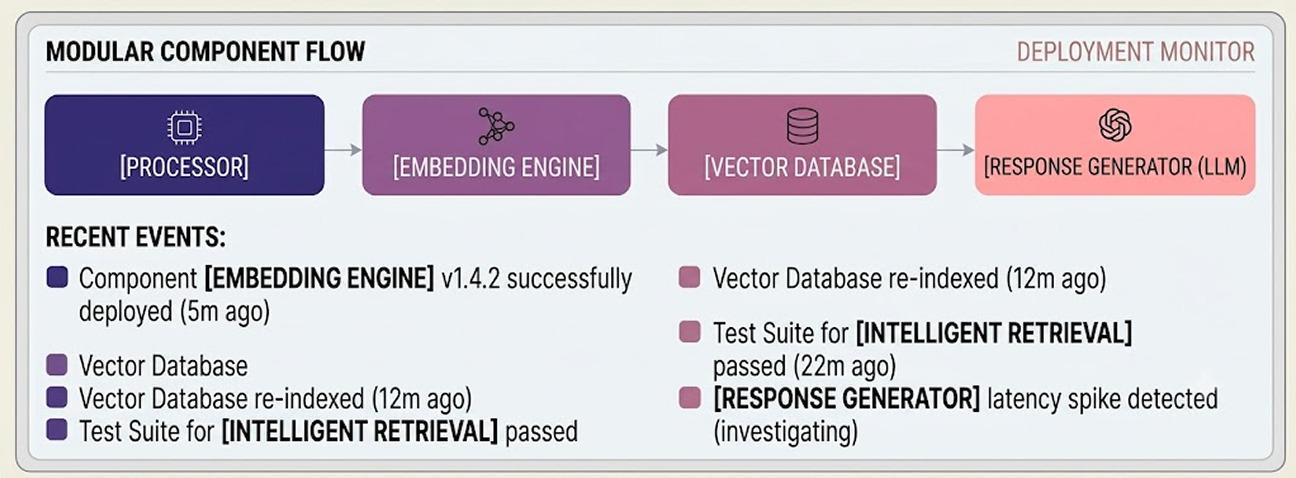
Observability Mockup

This modular approach makes applications easier to maintain, test, extend, and scale.

Application Layer

Your application contains the business logic, user interface, authentication, workflows, and user experience.

Enterprise Knowledge Assistant
Customer Support AI
HR Assistant

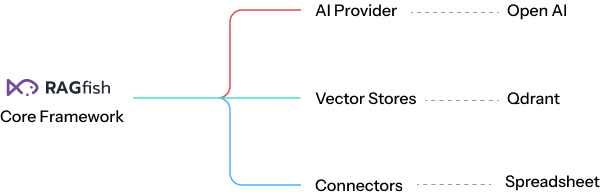
The Core Framework connects these technologies into a unified developer experience, allowing every component to work together seamlessly. Instead of writing custom integration code for every project, developers build on a stable foundation that is designed to grow with their applications.

Core Framework Architecture Graphic

Core Framework

View Core Framework

The Core Framework is the engine that coordinates every AI interaction. It is responsible for:

Framework configuration

This modular design allows developers to choose the AI providers, vector databases, and knowledge connectors that best fit their application while maintaining a consistent development experience.

  • Connectors ingest business data.
  • Apps manage users and workflows.
  • Choose AI providers and vector DBs.

Document ingestion

Ragfish connects directly to your existing data sources - databases, file storage, CMS platforms, or APIs - and pulls content in without requiring manual uploads or format conversion.

  • Auto-syncs data from sources.
  • Supports multiple file formats.
  • Updates without manual re-import.

Content chunking

Once ingested, documents are broken into smaller, meaningful segments that preserve context. This lets the AI retrieve precise, relevant information instead of returning entire documents.

  • Splits content into coherent segments. .
  • Preserves context across chunks.
  • Returns precise, relevant results.

Semantic retrieval

Instead of relying on exact keyword matches, Ragfish understands the meaning behind a query and retrieves the most relevant content — even when the wording differs from what's in the source data.

  • Matches queries by meaning, not keywords.
  • Ranks and surfaces relevant content.
  • Stays accurate across varied phrasing.

Chat orchestration

Ragfish manages the full conversation flow - tracking context across turns, routing queries to the right data sources, and assembling retrieved information into a clear, coherent response.


  • Maintains context across turns.
  • Auto-routes queries to connectors. .
  • Combines multiple sources in responses

AI Provider Layer

Large Language Models and embedding providers are implemented as dedicated packages.

Explore AI Provider

Current Support

OpenAI Icon

OpenAI

Future Support

Anthropic Claude

Anthropic Claude

Google Gemini

Google Gemini

Ollama

Ollama

Azure OpenAI Icon

Azure OpenAI

Mistral AI Icon

Mistral AI

Mistral AI Icon

Claude

Because providers follow a common interface, switching models requires minimal application changes.

Vector Store Layer

Vector databases store embeddings and perform similarity searches.

Explore Vector store

Current Support

Qdrant  Qdrant

Planned Support

Chroma
Pinecone
Milvus
Weaviate
PostgreSQL pgvector
MongoDB Atlas Vector Search

Connector Layer

Connectors import knowledge from different business systems.

Explore Connector

Current Support

Spreadsheet

Spreadsheet

Future Support

PDF
Database
Documents
Website
Notion
SharePoint
Google Drive
One Drive

Each connector focuses on extracting and preparing knowledge while the Core Framework handles indexing and retrieval.

Request Lifecycle

Every user question follows a structured retrieval pipeline.

User Question
Chat
Retriever
Vector Store
Relevant Chunks
AI Provider
Generated Response

Knowledge Processing Pipeline

Knowledge enters Ragfish through specialized connectors before becoming searchable.

Source Documents
Connector
Ingestion
Chunking
Embeddings
Vector Store

Package Architecture

Ragfish is distributed as a collection of independent packages.

Why This Architecture?

Modular

Every package has a single responsibility.

Extensible

Add new AI providers, vector stores, and connectors without modifying the Core Framework.

Flexible

Choose the technologies that best fit your application.

Maintainable

Independent packages make upgrades and maintenance easier.

Enterprise Ready

Designed for production deployments with long-term scalability in mind.

Consistency

Develop against a unified interface while using different storage technologies.

Designed for Growth

As your AI applications evolve, the Ragfish architecture grows with them.

You can begin with a simple AI assistant using OpenAI, Qdrant, and a Spreadsheet connector, then expand your solution by adding new providers, vector databases, and knowledge connectors—all while keeping the same application architecture.

Continue Your Journey

Understanding the architecture is the first step toward building with Ragfish.
Ready to Build with RAGfish?

Next, explore the Core Framework to learn how Settings, Ingestion, Chunking, Retrieval, and Chat work together to power intelligent AI applications.